Showing posts with label theory. Show all posts
Showing posts with label theory. Show all posts
Monday, April 5, 2010
The Pleasure of Absence
It is the pleasure of imagining a performance - or rather, of imagining a universe. A narrative, an aesthetics, an experience, a unity.
It is the pleasure of imagining a liveness, a directness, a presence.
The pleasure of experiencing the echo, the recording, the extract, the fragment of a copy of a copy. The pleasure Plato was so afraid of.
It is the joy of watching something on a small pixellated video image and imagining it live and juicily 3D.
It is the ecstatic moderato of my computer screen, of yours, which acts out the world that supposedly tastes better off-screen (heck, it tastes). Yet it is not off-screen, not in the performance space, but here, at this very desk, dressed in dark-green boxers, brown socks and a t-shirt, among the hills of papers and books and accompanied by the delicate sound of the washing machine and an occasional sms, that I experience it. The pleasure of absence. The ecstatic moderato.

The Pleasure of Absence
It is the pleasure of imagining a performance - or rather, of imagining a universe. A narrative, an aesthetics, an experience, a unity.
It is the pleasure of imagining a liveness, a directness, a presence.
The pleasure of experiencing the echo, the recording, the extract, the fragment of a copy of a copy. The pleasure Plato was so afraid of.
It is the joy of watching something on a small pixellated video image and imagining it live and juicily 3D.
It is the ecstatic moderato of my computer screen, of yours, which acts out the world that supposedly tastes better off-screen (heck, it tastes). Yet it is not off-screen, not in the performance space, but here, at this very desk, dressed in dark-green boxers, brown socks and a t-shirt, among the hills of papers and books and accompanied by the delicate sound of the washing machine and an occasional sms, that I experience it. The pleasure of absence. The ecstatic moderato.
Tuesday, December 29, 2009
The Splendorous Form of Noise
To see the following video you should enlarge it (double-click once playing).
The above is a compilation of works by the Swiss artist Zimoun.
1. Funny, one keeps telling oneself, enough of the minimal already, somehow feeling that less is a bore should be embraced, and the outrageously overflowing art of the recent years - appreciated and encouraged. And then, something like this appears, and it's irresistible. We've seen things from this universe before, also on this blog, and yet, the simplicity, yes, the damn purity takes over again.
2. I had a chance, recently, to visit several large factories. There were wonders there that could probably match most of the things on this video. Yet there was one thing they couldn't do: be useless. It's the sheer uselessness of it that gives it the power. We are not attached to anything but the thing. Art as the thing-that-cannot-be-used? Not necessarily, not in some purist sense. Great industrial design is to be cherished. And yet, there is a level of insanity here, of out-of-this-world-ness, that takes us to an exotic land, allowing for the silliest and most delicious connections to be made.
3. Luxury requires waste. A truly luxurious lifestyle is one where perfectly good things get wasted, as if to outplay their natural use and dying away. The true master of luxury seems to be saying her opulence is so great, the very perseverence of things is no match - they lose their original function and only exist to the extent they are participating in this out-of-this-world-ness of luxury.
You know what I'm aiming at? Here's the hypothesis:
4. This, this minimalist joyful pleasure-making, is the true luxury. Not the apparent richness of the new complexities. In the world of useless purity, everything only serves the joy of simple aesthetic pleasure. More complex works are not quite like that - they have an inner game to play. The elements enter a dialogue, start relations and societies, with their conflicts and functions and disruptions. Here, there is only the ping of a shot of pleasure. This engine moves nothing. It is here to make me smile (or bring inspiration, or scare) - and I turn it off as soon as I have. And don't be mistaken - if I had one of those and got bored with and could afford it, it would go to waste.
4a. Ah, you might say, but the truly great art is one we don't get bored with. Possibly. Yet how often do we actually go back to contemplate (not just think about or admire or analyze) a work of contemporary "minimalist" art? Does it mean it's because it's not that great? What if it's about something else? What if it is an element of luxury, a game we play with ourselves, to feel the exquisite taste of the sophisticated dish, and then to ditch it as soon as we're fed up? It wouldn't be a question of bluff, of fakeness, of shallowness. It would be a question of use. Of why we crave it, this new. Of how we make it useful after all.
 David Foldvari, Wrestler
(via)
The Splendorous Form of Noise
To see the following video you should enlarge it (double-click once playing).
The above is a compilation of works by the Swiss artist Zimoun.
1. Funny, one keeps telling oneself, enough of the minimal already, somehow feeling that less is a bore should be embraced, and the outrageously overflowing art of the recent years - appreciated and encouraged. And then, something like this appears, and it's irresistible. We've seen things from this universe before, also on this blog, and yet, the simplicity, yes, the damn purity takes over again.
2. I had a chance, recently, to visit several large factories. There were wonders there that could probably match most of the things on this video. Yet there was one thing they couldn't do: be useless. It's the sheer uselessness of it that gives it the power. We are not attached to anything but the thing. Art as the thing-that-cannot-be-used? Not necessarily, not in some purist sense. Great industrial design is to be cherished. And yet, there is a level of insanity here, of out-of-this-world-ness, that takes us to an exotic land, allowing for the silliest and most delicious connections to be made.
3. Luxury requires waste. A truly luxurious lifestyle is one where perfectly good things get wasted, as if to outplay their natural use and dying away. The true master of luxury seems to be saying her opulence is so great, the very perseverence of things is no match - they lose their original function and only exist to the extent they are participating in this out-of-this-world-ness of luxury.
You know what I'm aiming at? Here's the hypothesis:
4. This, this minimalist joyful pleasure-making, is the true luxury. Not the apparent richness of the new complexities. In the world of useless purity, everything only serves the joy of simple aesthetic pleasure. More complex works are not quite like that - they have an inner game to play. The elements enter a dialogue, start relations and societies, with their conflicts and functions and disruptions. Here, there is only the ping of a shot of pleasure. This engine moves nothing. It is here to make me smile (or bring inspiration, or scare) - and I turn it off as soon as I have. And don't be mistaken - if I had one of those and got bored with and could afford it, it would go to waste.
4a. Ah, you might say, but the truly great art is one we don't get bored with. Possibly. Yet how often do we actually go back to contemplate (not just think about or admire or analyze) a work of contemporary "minimalist" art? Does it mean it's because it's not that great? What if it's about something else? What if it is an element of luxury, a game we play with ourselves, to feel the exquisite taste of the sophisticated dish, and then to ditch it as soon as we're fed up? It wouldn't be a question of bluff, of fakeness, of shallowness. It would be a question of use. Of why we crave it, this new. Of how we make it useful after all.
David Foldvari, Wrestler
(via)
Saturday, September 26, 2009
Do You Believe In Magic? Grospierre vs. Radziszewski
a comparison of Karol Radziszewski's To Pee In a Bun and Nicolas Grospierre's Kunstkamera
The two recently* opened exhibitions at the main two contemporary art centers in Warsaw – Zachęta and the Contemporary Art Center – have some clear similarities.
Both exhibitions are witty, explicit dialogues with art history. They both play on the distance that separates contemporary art conventions from what has been somewhat recklessly left behind. Radziszewski exhibits works hidden in the depths of the national gallery’s archives. Some are excruciating to look at, others are curious discoveries or brilliant works. Grospierre goes back to the format of the Kunstkammer and does what he does best – plays with it.
They both focus on the structure of an exhibition, and make it an essential aspect, a sort of a meta-work which goes far beyond the classical idea of curator and uses the ambiguity of this function to the utmost. It is impossible to say where the curator’s role stops and the artist’s begins. This goes far beyond the inclusion of the curator’s own works in the exhibition, or his manipulation of the showing. We never know when the appreciation of the shown works is genuine, and when it is ironic. And because of the artists’ works being part of the selection, the self-irony is, as always, disarming.
However, each artist enacts the role of contemporary art trickster in a different way. Beyond questions of scale, budget and context of production, the two exhibitions are at two opposite sides of an old aesthetic debate. They present two different approaches to the question of value in aesthetics. But first, let me give you a brief description of each of the exhibitions.
Karol Radziszewski’s exhibition To Pee in a Bun, is grandiose. It is a personal take on the collection of Poland’s most renowned and respected public gallery of Modern Art (charmingly called The Encouragement for Fine Art).
 In it, he acts “merely” as curator, and also as one of the numerous exhibited artists. Here is what the curator had to say in a conversation with himself as artist :
We could say that Nicolas Grospierre creates a similar procedure of remixing curator and artist when in the Kunstkamera installation, (which is the size of one of the smaller rooms in Radziszewski’s exhibition), he hangs mainly pictures of objects and photos created by other people, and signs the whole as his piece.
 Yet the vectors, here, point elsewhere. Instead of spreading the works and opening, if not exploding, them, he seems to move inwards, closing the space and folding it yet again. Upon entering the "room", we discover a game of images reproducing images reproducing the same space with other images. The game goes on, like a play with mirrors, ad infinitum. The "meaning" is still ambiguous - yet it concentrates, thickens, moves toward inhabiting the space instead of abandoning it.

So what does all of this have to do with philosophical debates?
In an article published in 1936, Stanisław Ossowski, one of Poland’s most notable thinkers from the famous Lvov-Warsaw school of thought, argued against aesthetics understood as the “construction of value systems”. The generalizing of arbitrary aesthetic feelings and opinions to the level of theory should, in his opinion, give way to a sociological perspective on art and the aesthetic, one which would embrace the richness of opinions and points of view instead of imposing them.
This bold proposal was answered the same year by another great mind, Henryk Elzenberg, who argued that no matter how weak and prone to error, our aesthetic judgments remain anchored in value systems that can and should be discussed – as we cannot speak of aesthetics without referring to value, and values are open to discussion.
To put it bluntly: in Radziszewski’s exhibition I see Ossowski’s distancing from aesthetics as a system of values, while Grospierre’s installation follows Elzenberg’s ideals.
These are really two different ways of approaching the world.
Ossowski claims that any discussion about aesthetic values comes down to a power struggle. And this overpowering does not go through a sharing of enthusiasm or disgust, but goes through the attribution of value. Why? Elzenberg explains:
Hence the need for distance.
It seems Radziszewski claims it on every single step. On one hand, his collection is a moving away from an engaged position, it is rather a questioning of our aesthetic values, of their ever-astounding relativity and apparent insignificance. Who are we to say that this is pretty, and this isn’t? How are we to judge the works that a mere 30 years ago were judged outstanding, while today they’re hidden away in a museum cellar?

On the other hand though, Radziszewski’s approach differs from Ossowski’s philosophy in one respect: being an artist, and not a social scientist, he does not feel the need to eradicate the position of power. To the contrary, he exposes it by exploring it to the fullest. Why bring a porn film into the gallery? Because it’s shocking, and attracts audiences. The aestheticist’s position allows him to create values arbitrarily:
Grospierre is at a very different point. He does not feel the necessity to question everything – art history has done it sufficiently. Instead, he looks for ways of exploring the place of art today while not undoing it all yet again. Romantic? Certainly. It is a self-ironic romanticism, one that takes great effort in presenting itself as distanced and eye-winking. No wonder Grospierre cites Italo Calvino and Borges: this is the romantic universe that leads the battle for saving beauty. It is not, however, an intuitive aesthetic experience kind of beauty. The Kunstkamera is all about unending layers of initiation. It is a dive into the possibility of image, the possibility of the reflection of things, of some sort of hidden and evolving harmony between the object and the subject.

It reminds one of Heidegger’s conception of art as a window to some other realm we can in no other way describe. Here, this realm always crosses first an image of the reality we know – and so, we never know if this is the level of work-of-art, or it is only a description thereof. Fittingly, the exhibition flyer (a photocopy with clear photocopy marks) explains it all, and more. It seems to impose its vision of the work before we even get to see it.
Take, for instance, the “Trophies” section.
 The two positions can be called “metaphisical” and “positivist”. Elzenberg’s metaphisicist is
Or did the whole building of aesthetics collapse, leaving us in a void where any new creation of value is so easily ridiculed, art may at best be looked from a great distance, with an ironic, witty, sensitive yet unaffirming stance?
I must say I prefer Grospierre's installation: it's discursive and communicative, inquiring and playful, desperately searching for beauty, or maybe: aiming at beauty. This is a work of a believer. And although I'm not exactly a believer, I can repeat after one of my favorite characters, Samuel Hamilton: I don't really believe in it save that it works.
*It took me some time to write this... and tomorrow is the last day of Kunstkamera! Hurry if you want to see it.
The two recently* opened exhibitions at the main two contemporary art centers in Warsaw – Zachęta and the Contemporary Art Center – have some clear similarities.
Both exhibitions are witty, explicit dialogues with art history. They both play on the distance that separates contemporary art conventions from what has been somewhat recklessly left behind. Radziszewski exhibits works hidden in the depths of the national gallery’s archives. Some are excruciating to look at, others are curious discoveries or brilliant works. Grospierre goes back to the format of the Kunstkammer and does what he does best – plays with it.
They both focus on the structure of an exhibition, and make it an essential aspect, a sort of a meta-work which goes far beyond the classical idea of curator and uses the ambiguity of this function to the utmost. It is impossible to say where the curator’s role stops and the artist’s begins. This goes far beyond the inclusion of the curator’s own works in the exhibition, or his manipulation of the showing. We never know when the appreciation of the shown works is genuine, and when it is ironic. And because of the artists’ works being part of the selection, the self-irony is, as always, disarming.
However, each artist enacts the role of contemporary art trickster in a different way. Beyond questions of scale, budget and context of production, the two exhibitions are at two opposite sides of an old aesthetic debate. They present two different approaches to the question of value in aesthetics. But first, let me give you a brief description of each of the exhibitions.
Karol Radziszewski’s exhibition To Pee in a Bun, is grandiose. It is a personal take on the collection of Poland’s most renowned and respected public gallery of Modern Art (charmingly called The Encouragement for Fine Art).

 In it, he acts “merely” as curator, and also as one of the numerous exhibited artists. Here is what the curator had to say in a conversation with himself as artist :
C: Curators are the ones who make the artists conscious of
‘what’ they have created and ‘why’; often, they also manipulate the
works being displayed, creating their own narratives from pre-existing
works, at the same time disregarding their previous context.
A: Like you did in this exhibition?
C: Yes. (laughs)
A: Why?
C: I treat other artists’ works as elements of a larger whole, like
tubes of paint, from which I have to squeeze out colours in order
to paint one complex painting.
A: That’s a very colourful metaphor . . .
C: Thank you.
We could say that Nicolas Grospierre creates a similar procedure of remixing curator and artist when in the Kunstkamera installation, (which is the size of one of the smaller rooms in Radziszewski’s exhibition), he hangs mainly pictures of objects and photos created by other people, and signs the whole as his piece.
 Yet the vectors, here, point elsewhere. Instead of spreading the works and opening, if not exploding, them, he seems to move inwards, closing the space and folding it yet again. Upon entering the "room", we discover a game of images reproducing images reproducing the same space with other images. The game goes on, like a play with mirrors, ad infinitum. The "meaning" is still ambiguous - yet it concentrates, thickens, moves toward inhabiting the space instead of abandoning it.
So what does all of this have to do with philosophical debates?
In an article published in 1936, Stanisław Ossowski, one of Poland’s most notable thinkers from the famous Lvov-Warsaw school of thought, argued against aesthetics understood as the “construction of value systems”. The generalizing of arbitrary aesthetic feelings and opinions to the level of theory should, in his opinion, give way to a sociological perspective on art and the aesthetic, one which would embrace the richness of opinions and points of view instead of imposing them.
This bold proposal was answered the same year by another great mind, Henryk Elzenberg, who argued that no matter how weak and prone to error, our aesthetic judgments remain anchored in value systems that can and should be discussed – as we cannot speak of aesthetics without referring to value, and values are open to discussion.
To put it bluntly: in Radziszewski’s exhibition I see Ossowski’s distancing from aesthetics as a system of values, while Grospierre’s installation follows Elzenberg’s ideals.
These are really two different ways of approaching the world.
Ossowski claims that any discussion about aesthetic values comes down to a power struggle. And this overpowering does not go through a sharing of enthusiasm or disgust, but goes through the attribution of value. Why? Elzenberg explains:
Apparently [the value-based aestheticist] lacks qualifications: he does not have the authority, or the suggestive strength, or the capacity to contaminate others with his feeling. And he is overfilled with the will to rule. Thus, he tries to convince the victim that if this victim feels the same things he does, the victim will be right, he will be somehow objectively correct; and he will be wrong if he dares otherwise.
Hence the need for distance.
It seems Radziszewski claims it on every single step. On one hand, his collection is a moving away from an engaged position, it is rather a questioning of our aesthetic values, of their ever-astounding relativity and apparent insignificance. Who are we to say that this is pretty, and this isn’t? How are we to judge the works that a mere 30 years ago were judged outstanding, while today they’re hidden away in a museum cellar?

On the other hand though, Radziszewski’s approach differs from Ossowski’s philosophy in one respect: being an artist, and not a social scientist, he does not feel the need to eradicate the position of power. To the contrary, he exposes it by exploring it to the fullest. Why bring a porn film into the gallery? Because it’s shocking, and attracts audiences. The aestheticist’s position allows him to create values arbitrarily:
A: You’re a curator — does that mean power?
C: Absolute power! (laughs)
A: Most people believe curators are unfulfilled artists.
C: I think that does hold true for me. Besides, to quote Krasiński
yet again, ‘Art is too serious a business to be left in artists’ hands.’

Grospierre is at a very different point. He does not feel the necessity to question everything – art history has done it sufficiently. Instead, he looks for ways of exploring the place of art today while not undoing it all yet again. Romantic? Certainly. It is a self-ironic romanticism, one that takes great effort in presenting itself as distanced and eye-winking. No wonder Grospierre cites Italo Calvino and Borges: this is the romantic universe that leads the battle for saving beauty. It is not, however, an intuitive aesthetic experience kind of beauty. The Kunstkamera is all about unending layers of initiation. It is a dive into the possibility of image, the possibility of the reflection of things, of some sort of hidden and evolving harmony between the object and the subject.

It reminds one of Heidegger’s conception of art as a window to some other realm we can in no other way describe. Here, this realm always crosses first an image of the reality we know – and so, we never know if this is the level of work-of-art, or it is only a description thereof. Fittingly, the exhibition flyer (a photocopy with clear photocopy marks) explains it all, and more. It seems to impose its vision of the work before we even get to see it.
Take, for instance, the “Trophies” section.
Trophies represent four dog muzzles, belonging to the commonest of mongrels. Bolek, Majka, Eryk and Gucio are four doggies among thousands. In the old Wunderkammer we would find extraordinary or unique natural objects: the horn of a unicorn, huge crystals, stuffed reptiles and other monstrosities. The idea was to show nature in the most surprising forms. Today the world seems devoid of the mysteries and much simpler than in the sixteenth century: the monsters disappeared from biology books. Might it be that the world is less poetic, more prosaic? I don’t think so. Even if science discovered many of nature’s secrets, for me poetry and mystery are still present in nature – we can find them in the most common species, such as house dogs.
 The two positions can be called “metaphisical” and “positivist”. Elzenberg’s metaphisicist is
 quite aware that there are hundreds of traps on his way; that his individual chances of error are bigger than his chances of winning; he feels that his results are to the highest degree uncertain, endangered by others’ critique and by his own. He feels the constant risk. Yet this risk is also his joy, since, as a psychological type, he has in him – and indeed needs to have – a little bit of a man of adventure and his attitude towards the “positivist” is somewhat like the attitude of a sailor that knows he can drown, towards the landlubber, who has no such fiercely unpleasant risk awaiting. It gives him a sort of satisfaction, but that is not what decides about his behavior in terms of acquiring knowledge; the decisive factor is that he does not want to drown. And that is why he is first and foremost careful. The “Metaphisicist” – or rather, to put it in more serious terms, the valuing aestheticist – knows well that his subject is unclear and unattainable and that what he discovers in it flees any adequate descriptions. Thus, although he is a sui generis racionalist to start off, it is nonetheless easy to discover a trait in him that is the contrary of a strict rationalism: the tendency to treat concepts and judgments as merely a type of highly uncertain symbols of a reality that resists human thought. Thus, he will not suggest that the chiaroscuro in which he sees the thing is full light, nor will he bond himself till death due him part with this or that linguistic formula or even this or that discursive elaboration of his intuition. He – yes he! - has something in him of the spirit of empiricism, as he understands his moving into the subject as a multiplicity of attempts and returns, as the entering in contact, as a progressive bonding with reality. Hence, he has the quality of being critical towards his own achievements, he consciously softens the edges of his statements, and is ready for changes and corrections, and, generally speaking, is moderate and more moderate even.So do you believe in magic? In the aesthetic wonder of art, that keeps evolving beyond all expectations, that is in some strange way always related to beauty, and maintains some sort of objective common ground, some platform of shared values?
Or did the whole building of aesthetics collapse, leaving us in a void where any new creation of value is so easily ridiculed, art may at best be looked from a great distance, with an ironic, witty, sensitive yet unaffirming stance?
I must say I prefer Grospierre's installation: it's discursive and communicative, inquiring and playful, desperately searching for beauty, or maybe: aiming at beauty. This is a work of a believer. And although I'm not exactly a believer, I can repeat after one of my favorite characters, Samuel Hamilton: I don't really believe in it save that it works.
*It took me some time to write this... and tomorrow is the last day of Kunstkamera! Hurry if you want to see it.
Do You Believe In Magic? Grospierre vs. Radziszewski
a comparison of Karol Radziszewski's To Pee In a Bun and Nicolas Grospierre's Kunstkamera
The two recently* opened exhibitions at the main two contemporary art centers in Warsaw – Zachęta and the Contemporary Art Center – have some clear similarities.
Both exhibitions are witty, explicit dialogues with art history. They both play on the distance that separates contemporary art conventions from what has been somewhat recklessly left behind. Radziszewski exhibits works hidden in the depths of the national gallery’s archives. Some are excruciating to look at, others are curious discoveries or brilliant works. Grospierre goes back to the format of the Kunstkammer and does what he does best – plays with it.
They both focus on the structure of an exhibition, and make it an essential aspect, a sort of a meta-work which goes far beyond the classical idea of curator and uses the ambiguity of this function to the utmost. It is impossible to say where the curator’s role stops and the artist’s begins. This goes far beyond the inclusion of the curator’s own works in the exhibition, or his manipulation of the showing. We never know when the appreciation of the shown works is genuine, and when it is ironic. And because of the artists’ works being part of the selection, the self-irony is, as always, disarming.
However, each artist enacts the role of contemporary art trickster in a different way. Beyond questions of scale, budget and context of production, the two exhibitions are at two opposite sides of an old aesthetic debate. They present two different approaches to the question of value in aesthetics. But first, let me give you a brief description of each of the exhibitions.
Karol Radziszewski’s exhibition To Pee in a Bun, is grandiose. It is a personal take on the collection of Poland’s most renowned and respected public gallery of Modern Art (charmingly called The Encouragement for Fine Art).
In it, he acts “merely” as curator, and also as one of the numerous exhibited artists. Here is what the curator had to say in a conversation with himself as artist :
We could say that Nicolas Grospierre creates a similar procedure of remixing curator and artist when in the Kunstkamera installation, (which is the size of one of the smaller rooms in Radziszewski’s exhibition), he hangs mainly pictures of objects and photos created by other people, and signs the whole as his piece.
Yet the vectors, here, point elsewhere. Instead of spreading the works and opening, if not exploding, them, he seems to move inwards, closing the space and folding it yet again. Upon entering the "room", we discover a game of images reproducing images reproducing the same space with other images. The game goes on, like a play with mirrors, ad infinitum. The "meaning" is still ambiguous - yet it concentrates, thickens, moves toward inhabiting the space instead of abandoning it.
So what does all of this have to do with philosophical debates?
In an article published in 1936, Stanisław Ossowski, one of Poland’s most notable thinkers from the famous Lvov-Warsaw school of thought, argued against aesthetics understood as the “construction of value systems”. The generalizing of arbitrary aesthetic feelings and opinions to the level of theory should, in his opinion, give way to a sociological perspective on art and the aesthetic, one which would embrace the richness of opinions and points of view instead of imposing them.
This bold proposal was answered the same year by another great mind, Henryk Elzenberg, who argued that no matter how weak and prone to error, our aesthetic judgments remain anchored in value systems that can and should be discussed – as we cannot speak of aesthetics without referring to value, and values are open to discussion.
To put it bluntly: in Radziszewski’s exhibition I see Ossowski’s distancing from aesthetics as a system of values, while Grospierre’s installation follows Elzenberg’s ideals.
These are really two different ways of approaching the world.
Ossowski claims that any discussion about aesthetic values comes down to a power struggle. And this overpowering does not go through a sharing of enthusiasm or disgust, but goes through the attribution of value. Why? Elzenberg explains:
Hence the need for distance.
It seems Radziszewski claims it on every single step. On one hand, his collection is a moving away from an engaged position, it is rather a questioning of our aesthetic values, of their ever-astounding relativity and apparent insignificance. Who are we to say that this is pretty, and this isn’t? How are we to judge the works that a mere 30 years ago were judged outstanding, while today they’re hidden away in a museum cellar?
On the other hand though, Radziszewski’s approach differs from Ossowski’s philosophy in one respect: being an artist, and not a social scientist, he does not feel the need to eradicate the position of power. To the contrary, he exposes it by exploring it to the fullest. Why bring a porn film into the gallery? Because it’s shocking, and attracts audiences. The aestheticist’s position allows him to create values arbitrarily:
Grospierre is at a very different point. He does not feel the necessity to question everything – art history has done it sufficiently. Instead, he looks for ways of exploring the place of art today while not undoing it all yet again. Romantic? Certainly. It is a self-ironic romanticism, one that takes great effort in presenting itself as distanced and eye-winking. No wonder Grospierre cites Italo Calvino and Borges: this is the romantic universe that leads the battle for saving beauty. It is not, however, an intuitive aesthetic experience kind of beauty. The Kunstkamera is all about unending layers of initiation. It is a dive into the possibility of image, the possibility of the reflection of things, of some sort of hidden and evolving harmony between the object and the subject.
It reminds one of Heidegger’s conception of art as a window to some other realm we can in no other way describe. Here, this realm always crosses first an image of the reality we know – and so, we never know if this is the level of work-of-art, or it is only a description thereof. Fittingly, the exhibition flyer (a photocopy with clear photocopy marks) explains it all, and more. It seems to impose its vision of the work before we even get to see it.
Take, for instance, the “Trophies” section.
The two positions can be called “metaphisical” and “positivist”. Elzenberg’s metaphisicist is
Or did the whole building of aesthetics collapse, leaving us in a void where any new creation of value is so easily ridiculed, art may at best be looked from a great distance, with an ironic, witty, sensitive yet unaffirming stance?
I must say I prefer Grospierre's installation: it's discursive and communicative, inquiring and playful, desperately searching for beauty, or maybe: aiming at beauty. This is a work of a believer. And although I'm not exactly a believer, I can repeat after one of my favorite characters, Samuel Hamilton: I don't really believe in it save that it works.
*It took me some time to write this... and tomorrow is the last day of Kunstkamera! Hurry if you want to see it.
The two recently* opened exhibitions at the main two contemporary art centers in Warsaw – Zachęta and the Contemporary Art Center – have some clear similarities.
Both exhibitions are witty, explicit dialogues with art history. They both play on the distance that separates contemporary art conventions from what has been somewhat recklessly left behind. Radziszewski exhibits works hidden in the depths of the national gallery’s archives. Some are excruciating to look at, others are curious discoveries or brilliant works. Grospierre goes back to the format of the Kunstkammer and does what he does best – plays with it.
They both focus on the structure of an exhibition, and make it an essential aspect, a sort of a meta-work which goes far beyond the classical idea of curator and uses the ambiguity of this function to the utmost. It is impossible to say where the curator’s role stops and the artist’s begins. This goes far beyond the inclusion of the curator’s own works in the exhibition, or his manipulation of the showing. We never know when the appreciation of the shown works is genuine, and when it is ironic. And because of the artists’ works being part of the selection, the self-irony is, as always, disarming.
However, each artist enacts the role of contemporary art trickster in a different way. Beyond questions of scale, budget and context of production, the two exhibitions are at two opposite sides of an old aesthetic debate. They present two different approaches to the question of value in aesthetics. But first, let me give you a brief description of each of the exhibitions.
Karol Radziszewski’s exhibition To Pee in a Bun, is grandiose. It is a personal take on the collection of Poland’s most renowned and respected public gallery of Modern Art (charmingly called The Encouragement for Fine Art).
In it, he acts “merely” as curator, and also as one of the numerous exhibited artists. Here is what the curator had to say in a conversation with himself as artist :C: Curators are the ones who make the artists conscious of
‘what’ they have created and ‘why’; often, they also manipulate the
works being displayed, creating their own narratives from pre-existing
works, at the same time disregarding their previous context.
A: Like you did in this exhibition?
C: Yes. (laughs)
A: Why?
C: I treat other artists’ works as elements of a larger whole, like
tubes of paint, from which I have to squeeze out colours in order
to paint one complex painting.
A: That’s a very colourful metaphor . . .
C: Thank you.
We could say that Nicolas Grospierre creates a similar procedure of remixing curator and artist when in the Kunstkamera installation, (which is the size of one of the smaller rooms in Radziszewski’s exhibition), he hangs mainly pictures of objects and photos created by other people, and signs the whole as his piece.
Yet the vectors, here, point elsewhere. Instead of spreading the works and opening, if not exploding, them, he seems to move inwards, closing the space and folding it yet again. Upon entering the "room", we discover a game of images reproducing images reproducing the same space with other images. The game goes on, like a play with mirrors, ad infinitum. The "meaning" is still ambiguous - yet it concentrates, thickens, moves toward inhabiting the space instead of abandoning it.So what does all of this have to do with philosophical debates?
In an article published in 1936, Stanisław Ossowski, one of Poland’s most notable thinkers from the famous Lvov-Warsaw school of thought, argued against aesthetics understood as the “construction of value systems”. The generalizing of arbitrary aesthetic feelings and opinions to the level of theory should, in his opinion, give way to a sociological perspective on art and the aesthetic, one which would embrace the richness of opinions and points of view instead of imposing them.
This bold proposal was answered the same year by another great mind, Henryk Elzenberg, who argued that no matter how weak and prone to error, our aesthetic judgments remain anchored in value systems that can and should be discussed – as we cannot speak of aesthetics without referring to value, and values are open to discussion.
To put it bluntly: in Radziszewski’s exhibition I see Ossowski’s distancing from aesthetics as a system of values, while Grospierre’s installation follows Elzenberg’s ideals.
These are really two different ways of approaching the world.
Ossowski claims that any discussion about aesthetic values comes down to a power struggle. And this overpowering does not go through a sharing of enthusiasm or disgust, but goes through the attribution of value. Why? Elzenberg explains:
Apparently [the value-based aestheticist] lacks qualifications: he does not have the authority, or the suggestive strength, or the capacity to contaminate others with his feeling. And he is overfilled with the will to rule. Thus, he tries to convince the victim that if this victim feels the same things he does, the victim will be right, he will be somehow objectively correct; and he will be wrong if he dares otherwise.
Hence the need for distance.
It seems Radziszewski claims it on every single step. On one hand, his collection is a moving away from an engaged position, it is rather a questioning of our aesthetic values, of their ever-astounding relativity and apparent insignificance. Who are we to say that this is pretty, and this isn’t? How are we to judge the works that a mere 30 years ago were judged outstanding, while today they’re hidden away in a museum cellar?
On the other hand though, Radziszewski’s approach differs from Ossowski’s philosophy in one respect: being an artist, and not a social scientist, he does not feel the need to eradicate the position of power. To the contrary, he exposes it by exploring it to the fullest. Why bring a porn film into the gallery? Because it’s shocking, and attracts audiences. The aestheticist’s position allows him to create values arbitrarily:
A: You’re a curator — does that mean power?
C: Absolute power! (laughs)
A: Most people believe curators are unfulfilled artists.
C: I think that does hold true for me. Besides, to quote Krasiński
yet again, ‘Art is too serious a business to be left in artists’ hands.’
Grospierre is at a very different point. He does not feel the necessity to question everything – art history has done it sufficiently. Instead, he looks for ways of exploring the place of art today while not undoing it all yet again. Romantic? Certainly. It is a self-ironic romanticism, one that takes great effort in presenting itself as distanced and eye-winking. No wonder Grospierre cites Italo Calvino and Borges: this is the romantic universe that leads the battle for saving beauty. It is not, however, an intuitive aesthetic experience kind of beauty. The Kunstkamera is all about unending layers of initiation. It is a dive into the possibility of image, the possibility of the reflection of things, of some sort of hidden and evolving harmony between the object and the subject.
It reminds one of Heidegger’s conception of art as a window to some other realm we can in no other way describe. Here, this realm always crosses first an image of the reality we know – and so, we never know if this is the level of work-of-art, or it is only a description thereof. Fittingly, the exhibition flyer (a photocopy with clear photocopy marks) explains it all, and more. It seems to impose its vision of the work before we even get to see it.
Take, for instance, the “Trophies” section.
Trophies represent four dog muzzles, belonging to the commonest of mongrels. Bolek, Majka, Eryk and Gucio are four doggies among thousands. In the old Wunderkammer we would find extraordinary or unique natural objects: the horn of a unicorn, huge crystals, stuffed reptiles and other monstrosities. The idea was to show nature in the most surprising forms. Today the world seems devoid of the mysteries and much simpler than in the sixteenth century: the monsters disappeared from biology books. Might it be that the world is less poetic, more prosaic? I don’t think so. Even if science discovered many of nature’s secrets, for me poetry and mystery are still present in nature – we can find them in the most common species, such as house dogs.
The two positions can be called “metaphisical” and “positivist”. Elzenberg’s metaphisicist is quite aware that there are hundreds of traps on his way; that his individual chances of error are bigger than his chances of winning; he feels that his results are to the highest degree uncertain, endangered by others’ critique and by his own. He feels the constant risk. Yet this risk is also his joy, since, as a psychological type, he has in him – and indeed needs to have – a little bit of a man of adventure and his attitude towards the “positivist” is somewhat like the attitude of a sailor that knows he can drown, towards the landlubber, who has no such fiercely unpleasant risk awaiting. It gives him a sort of satisfaction, but that is not what decides about his behavior in terms of acquiring knowledge; the decisive factor is that he does not want to drown. And that is why he is first and foremost careful. The “Metaphisicist” – or rather, to put it in more serious terms, the valuing aestheticist – knows well that his subject is unclear and unattainable and that what he discovers in it flees any adequate descriptions. Thus, although he is a sui generis racionalist to start off, it is nonetheless easy to discover a trait in him that is the contrary of a strict rationalism: the tendency to treat concepts and judgments as merely a type of highly uncertain symbols of a reality that resists human thought. Thus, he will not suggest that the chiaroscuro in which he sees the thing is full light, nor will he bond himself till death due him part with this or that linguistic formula or even this or that discursive elaboration of his intuition. He – yes he! - has something in him of the spirit of empiricism, as he understands his moving into the subject as a multiplicity of attempts and returns, as the entering in contact, as a progressive bonding with reality. Hence, he has the quality of being critical towards his own achievements, he consciously softens the edges of his statements, and is ready for changes and corrections, and, generally speaking, is moderate and more moderate even.So do you believe in magic? In the aesthetic wonder of art, that keeps evolving beyond all expectations, that is in some strange way always related to beauty, and maintains some sort of objective common ground, some platform of shared values?
Or did the whole building of aesthetics collapse, leaving us in a void where any new creation of value is so easily ridiculed, art may at best be looked from a great distance, with an ironic, witty, sensitive yet unaffirming stance?
I must say I prefer Grospierre's installation: it's discursive and communicative, inquiring and playful, desperately searching for beauty, or maybe: aiming at beauty. This is a work of a believer. And although I'm not exactly a believer, I can repeat after one of my favorite characters, Samuel Hamilton: I don't really believe in it save that it works.
*It took me some time to write this... and tomorrow is the last day of Kunstkamera! Hurry if you want to see it.
Thursday, September 24, 2009
Lightness is Difficult


As a wise man once said, life is serious, art is lighthearted. And this very description is what I find the most difficult about creating art. There is a tremendous distance between the seriousness of living a life (yes, even an artist's life...), and the light that the art requires.
Or is it the heart?
Both works are by Collier Schorr.
Lightness is Difficult
As a wise man once said, life is serious, art is lighthearted. And this very description is what I find the most difficult about creating art. There is a tremendous distance between the seriousness of living a life (yes, even an artist's life...), and the light that the art requires.
Or is it the heart?
Both works are by Collier Schorr.
Wednesday, August 12, 2009
Sensing discourse

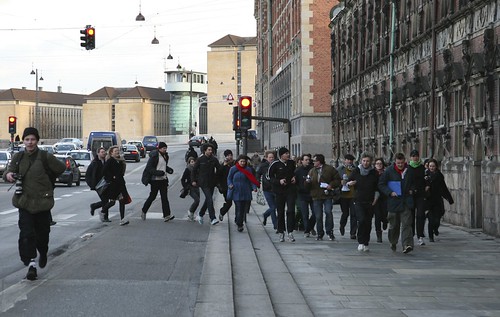
"- What is the role of the artist?
- To not get tired of running all his life."
The Critical Run initiative, by Thierry Geoffroy, at first glance, appears exciting. Lighthearted and simple, yet livening. Take a group of people and make them discuss serious issues - while jogging.
Let's run and talk. Let's have fun and share. Let's move. See what happens - to us, to the surroundings, to the topic.
It reminds me of some of the Lone Twin works, and of other, more discursive, initatives.
But then you see the videos.
- and you realize why this is a copyrighted format. Actually, it's not about the conversation at all. It's about the hilarious situation of displacing discourse into a territory that is not its own. It's about creating a mess with a mass. And hoping (?) for a miracle of super-discourse through a discourse-smashing environment. As we all know from films, the most profound ideas arise on boxing rings.
But wait! It gets better!
Oh, Canada!
Think! Exchange! Travel far! As long as you can fit it on a headband...
But let's be honest. Discourse is a problem for the work of art, if it stays within the aesthetic experience. It either gets chewn up by the experience or we move out (last movement?) of the aesthetic experience and into the realm of plays-on-ideas. Which is also a tough blow.
Then we have to face the perspective of functioning as anyone else who thinks. And running with them. And quite possibly getting completely lost, syncopated, out-of-breathed, shafted, as my teenage years would put it (notice the momentum of the word). No wonder one can feel the need to go back and, well, try to, well, do, well, something about the loss. Someone like John Baldessari*, witty enough to both play the artsy world and keep his eyes on the ball:
And, to get a fuller picture, how else, a remix of the remix:
Is the relief you feel when being able to read accompanied by a feeling of the loss of Baldessari's purity? Could it be there is not enough movement? But then again, isn't it nice to feel that a words translates into a thought?
One of the videos of the Critical Runs is entitled "Does the artist has any impact on society?" (sic!)
There is one comment underneath: "Not in bad English you don't. Does anyone have..."
* For a succint intro to John Baldessari, see the stylishly designed FLYP magazine.
Sensing discourse
"- What is the role of the artist?
- To not get tired of running all his life."
The Critical Run initiative, by Thierry Geoffroy, at first glance, appears exciting. Lighthearted and simple, yet livening. Take a group of people and make them discuss serious issues - while jogging.
Let's run and talk. Let's have fun and share. Let's move. See what happens - to us, to the surroundings, to the topic.
It reminds me of some of the Lone Twin works, and of other, more discursive, initatives.
But then you see the videos.
- and you realize why this is a copyrighted format. Actually, it's not about the conversation at all. It's about the hilarious situation of displacing discourse into a territory that is not its own. It's about creating a mess with a mass. And hoping (?) for a miracle of super-discourse through a discourse-smashing environment. As we all know from films, the most profound ideas arise on boxing rings.
But wait! It gets better!
Oh, Canada!
Think! Exchange! Travel far! As long as you can fit it on a headband...
But let's be honest. Discourse is a problem for the work of art, if it stays within the aesthetic experience. It either gets chewn up by the experience or we move out (last movement?) of the aesthetic experience and into the realm of plays-on-ideas. Which is also a tough blow.
Then we have to face the perspective of functioning as anyone else who thinks. And running with them. And quite possibly getting completely lost, syncopated, out-of-breathed, shafted, as my teenage years would put it (notice the momentum of the word). No wonder one can feel the need to go back and, well, try to, well, do, well, something about the loss. Someone like John Baldessari*, witty enough to both play the artsy world and keep his eyes on the ball:
And, to get a fuller picture, how else, a remix of the remix:
Is the relief you feel when being able to read accompanied by a feeling of the loss of Baldessari's purity? Could it be there is not enough movement? But then again, isn't it nice to feel that a words translates into a thought?
One of the videos of the Critical Runs is entitled "Does the artist has any impact on society?" (sic!)
There is one comment underneath: "Not in bad English you don't. Does anyone have..."
* For a succint intro to John Baldessari, see the stylishly designed FLYP magazine.
Friday, June 5, 2009
FC Barcelona and the shift of aesthetic paradigms
Apparently the manager of FC Barelona, the young Josep Guardiola, prepared this film for his players before the finale against Manchester United. And before the game, instead of making the classic motivational speech, he showed them the film. And said nothing afterwards.
If I'm posting this on the New Art blog, it's because this shows a very powerful turn in the way we see film/media. Although the advent of the "TV era" has been prophetized for a long time, and many declared its beginning many decades ago. However, this event, for me, is a very important sign of a shift of paradigms. And it is not as simple as moving from a deep human experience to a superficial "screen" experience. The presence of the manager, of the person, is still crucial (it would be difficult to imagine - for the moment - that he weren't there), but his action is not. Hence, translating it into performative terms, we can say it is not about the actor-audience connection, as some sort of a mystic communion. And a possible reason so many thinkers complain is because they thought the aesthetic experience of a live event had some "added value" because of it being inter-subjective. Suddenly, it appears the inter-subjectivity is just one possible aspect. One that can be done away with - while maintaining, and that is my argument, the value of the experience. Yes, now it seems more about the show-spectacle, but this is not to say the "spectacle" is, as such, of lesser value (based on what?). For one, it appears as a surprizingly intimate event. And if the film will presumably seem kitsch to most of us, that is clearly because it was tailored for a specific audience, with specific references, under very special circumstances. Could it be that this type of intimate media spectacle is what's in the air?
FC Barcelona and the shift of aesthetic paradigms
Apparently the manager of FC Barelona, the young Josep Guardiola, prepared this film for his players before the finale against Manchester United. And before the game, instead of making the classic motivational speech, he showed them the film. And said nothing afterwards.
If I'm posting this on the New Art blog, it's because this shows a very powerful turn in the way we see film/media. Although the advent of the "TV era" has been prophetized for a long time, and many declared its beginning many decades ago. However, this event, for me, is a very important sign of a shift of paradigms. And it is not as simple as moving from a deep human experience to a superficial "screen" experience. The presence of the manager, of the person, is still crucial (it would be difficult to imagine - for the moment - that he weren't there), but his action is not. Hence, translating it into performative terms, we can say it is not about the actor-audience connection, as some sort of a mystic communion. And a possible reason so many thinkers complain is because they thought the aesthetic experience of a live event had some "added value" because of it being inter-subjective. Suddenly, it appears the inter-subjectivity is just one possible aspect. One that can be done away with - while maintaining, and that is my argument, the value of the experience. Yes, now it seems more about the show-spectacle, but this is not to say the "spectacle" is, as such, of lesser value (based on what?). For one, it appears as a surprizingly intimate event. And if the film will presumably seem kitsch to most of us, that is clearly because it was tailored for a specific audience, with specific references, under very special circumstances. Could it be that this type of intimate media spectacle is what's in the air?
Tuesday, May 19, 2009
Of the daemon
I am not a person particularly given to metaphysical beliefs.
I tend to be cautious in the way I describe the world, and the parts where I allow myself to travel further are, in my perspective, mere mental experiments, or even tricks of the (artistic) trade.
Yet I wish I could simply apply Elizabeth Gilbert's advice and speak out to whatever is out there, negociating with me what comes to my mind.
It's not an easy task. The skepticism rushes in, and I am reminded by myself that, after all, it all remains a metaphor, and although I might be producing things I myself do not expect (that seems to be the rule), I do not know how my heart functions, either, or why I start to sweat or how I fall asleep. The more carefuly I look at myself, the less of what I do can be divided into conscious and unconscious activity. Ergo, I can assume creativity is also somewhere within that quasi-conscious reign that to me should appear no more familiar, or "mine", than yawning.
But, deep down inside, I am also a dreamer. I love to think I'm lucky. I like pretty formulas, and feel very precisely how sometimes things go right. There you have it: here is an opening for metaphysics. If I am so easily tempted to create all these invisible structures, strings and forces, why can't I accept the simple idea that there is someone, something, a daemon, that negociates with me everything I do? Why, for heaven's sake, not accept something that makes your life easier? For the sake of truth? In art?
Of the daemon
I am not a person particularly given to metaphysical beliefs.
I tend to be cautious in the way I describe the world, and the parts where I allow myself to travel further are, in my perspective, mere mental experiments, or even tricks of the (artistic) trade.
Yet I wish I could simply apply Elizabeth Gilbert's advice and speak out to whatever is out there, negociating with me what comes to my mind.
It's not an easy task. The skepticism rushes in, and I am reminded by myself that, after all, it all remains a metaphor, and although I might be producing things I myself do not expect (that seems to be the rule), I do not know how my heart functions, either, or why I start to sweat or how I fall asleep. The more carefuly I look at myself, the less of what I do can be divided into conscious and unconscious activity. Ergo, I can assume creativity is also somewhere within that quasi-conscious reign that to me should appear no more familiar, or "mine", than yawning.
But, deep down inside, I am also a dreamer. I love to think I'm lucky. I like pretty formulas, and feel very precisely how sometimes things go right. There you have it: here is an opening for metaphysics. If I am so easily tempted to create all these invisible structures, strings and forces, why can't I accept the simple idea that there is someone, something, a daemon, that negociates with me everything I do? Why, for heaven's sake, not accept something that makes your life easier? For the sake of truth? In art?
Tuesday, January 15, 2008
A few amazing finds, and a very subjective text

Magnus von Plessen, Felicity
It is hard for me to imagine a live performance that would have (that I would find to have) the density of some visual art. Yes, I distinguish those quite clearly, mainly by the dilating of senses I experience when watching most performance, as if there was no way of just getting to the point, or points, or of just hitting me with whatever they have. "Just". There is justice in this just, a sense of the right measure, like an object where the proportions feel right. I simply cannot recall a single performance I have seen where the proportions just felt right. It seems time and a live body introduce elements that are somehow completely out of the scope of my spectator experience.
Compare the best you've seen on stage to this:


The above images, by the astonishing Tim Hawkinson, are more than powerful: they range from publicity-like to classical sculpture to highly conceptual (the last one is a self-portrait mapping of all the area the artist sees on his own body, the picture before is a Balloon Self-Portrait, a blown-up mold of the artist), and yet each of them seems complete.
Or see these, by Huma Bhabha:


How are we to compete with the perfection of something that is? Another language, you will say. Another state of presence. And yet, the choice of what to lay my eyes on remains. And diversity is no argument, when time after time what is live seems to be disappointing, less thrilling, less surprising, exciting, fresh and bold than what remains there not waiting for the sight. But then again, it is also less exciting than film, which seems only to live when seen!
Indeed, it is perfectly useless to speak of the spectator's responsibility in all this, when the spectator admits he is not up to it and instead choses something less desperate, even as it may be darker and, at least on the surface, less active.

 (Both poor quality reproductions are by Magnus von Plessen)
And yet, after having written all this, I still feel that live art somehow retains an incredible potential. Not because it is live, at least in the sense of having live people in front of you, but rather, in the sense of it being an event, and so, something that remains unexpected, but also unfinished, incomplete, and fragile in its egomaniacal form ("look at me!"). I'm still not sure where this is heading, it remains confused, but it might have something to do with the amazing phenomenon of enjoying something while it is bad, enjoying it because you appreciate it as an event, enjoying the fact that you are in the privileged position of
PS: Here is a picture dedicated to the effort of some colleagues from a theater project that has been on these days:
 (The picture is by Amy Stein. I believe the title is Domesticated.)
Friday, December 14, 2007
How small is history?

In a comment in the Portuguese daily newspaper Público, my colleague Tiago Bartolomeu Costa commented on a controversial artistic residency at the Gulbenkian Foundation, which ended in October with a presentation of the works. A number of young visual and performance artists were invited for a 2-month residency in the very space where the Foundation’s collection of contemporary Portuguese art is usually presented. The place was completely transformed into 30 large cubicles or divisions. Visitors to the museum could eavesdrop and discover how each artist develops his work, as the space opened for the general public during several hours in the afternoon. Theoretically, one could accompany the entire process day-by-day (I wonder if anyone tried).
The entire (impressive and extensive) program which incorporated this daring initiative is called The State of the World, and this very title makes me feel somewhat uneasy. But first, let's hear Tiago:
Generally speaking, the protagonists of the arts of the body that were present [during the day of presentation] seem to have wasted an opportunity to reflect about what it means to create today. (...) the propositions (...) had in common what the artist Christian Boltanski called "the small memory" (...), but which to many of the creators became a runaway solution [in Portuguese: escape]: an apology of the idea that a selection of immediate and generational references can substitute, without any loss, History's evolutive processes.There are several very important statements implied in this short fragment.
1) That there is a History. And not many histories, stories, lines. Indeed, in this perspective it is clear that the artists Tiago speaks of missed the point completely. However, "History" remains to be proven. And although History's end has been suspended, this still does not mean we have but the choice of either facing it or questioning it. But the very fact that the word appears here, in all its capital-letter majesty, is not benign. It has to do with the very opinion that artists should work on something called "The State of the World". What World? What State? What are we to do of the the legacy of the last 40 years of thought (and Boltanski is in the midst of it), with its “shift from history to discourse, from a third- to a second-person address” (Craig Owen, quoted from a famous essay called The Allegorical Impulse: Toward a Theory of Postmodernism
 )?
)?2) That there is an evolution, and that it can be ceased. This does make sense if we see any change as evolution. And makes a very interesting point: how do we feel evolution today? Beyond terrorism and cell phones, how does our (my) world pulsate? What leaks? What swallows? What itches? What feels good? I quite agree with Tiago that there is a tension that remains to be read, deciphered, discovered. However,
3) Shouldn't we accept this sort of intimate storytelling as an acceptance of one's own limits, an artistic modesty that is praiseworthy? It might go further than the postmodernist paradigm described through Craig Owens’ words. There is a telling slip of the tongue in the comment. If we read it literally, it suggests that the "selection of references" cannot "substitute History". This, however, implies that the artists put the generational references as an ontological substitute for History's processes. Which they don't (nobody declares or implies that the processes are susbsitututed). The problem might be precisely this: in the case of some of the young performers, the artistic discourse doesn't seem to come near the question of histories vs. History. The modesty seems almost unconscious, more like a limitation than a choice or perspective.
So Tiago does raise an important issue: how can art deal with the world and its new type of globality? We are more conscious today of what the world is than ever before. Might that be why we are more reluctant to generalize, or even try and define its processes? But can we just turn away and ignore them? Of course we can. So why would we participate in an event called State of the World? On one hand, this "small talk" of the "small memory" could be saying a lot about the State of the World, seen from here and now. On the other, its difficulty with approaching these Capital-Lettered-Concepts could be a hint that maybe its time to start off without the caps.
Here is a poem by Wislawa Szymborska, the Polish Nobel-Prize-Winner:
No Title Required
It has come to this: I’m sitting under a tree
beside a river
on a sunny morning.
It’s an insignificant event
and won’t go down in history.
It’s not battles and pacts,
where motives are scrutinized,
or noteworthy tyrannicides.
And yet I’m sitting by this river, that’s a fact.
And since I’m here
I must have come from somewhere,
and before that
I must have turned up in many other places,
exactly like the conquerors of nations
before setting sail.
Even a passing moment has its fertile past,
its Friday before Saturday,
its May before June.
Its horizons are no less real
than those that a marshal’s field glasses might scan.
This tree is a poplar that’s been rooted here for years.
The river is the Raba; it didn’t spring up yesterday.
The path leading through the bushes
wasn’t beaten last week.
The wind had to blow the clouds here
before it could blow them away.
And though nothing much is going on nearby,
the world is no poorer in details for that.
It’s just as grounded, just as definite
as when migrating races held it captive.
Conspiracies aren’t the only things shrouded in silence.
Retinues of reasons don’t trail coronations alone.
Anniversaries of revolutions may roll around,
but so do oval pebbles encircling the bay.
The tapestry of circumstance is intricate and dense.
Ants stitching in the grass.
The grass sewn into the ground.
The pattern of a wave being needled by a twig.
So it happens that I am and look.
Above me a white butterfly is fluttering through the air
on wings that are its alone,
and a shadow skims through my hands
that is none other than itself, no one else’s but its own.
When I see such things, I’m no longer sure
that what’s important
is more important than what’s not.
I know, Tiago - the big question remains: is this, can this small memory be enough? Can we spend time watching little branches and the butterflies' wings, and claim to any sort of authority in regards to the State of the World, or the states of the worlds, for that matter?
It's a beautiful poem. One of the things I like most about it, though, is that Szymborska is not sure. There is a hesitation here. While us, poor contemporary creative bastards, often take it for granted. We just move on, as if this was it.
How many capital letters can we keep? How many should we? Is it a question of the times that are a-changin? The closest I ever came to a war was when the tanks appeared on the streets in Poland in 1981. I was 3. My memory of it is fairly clear. But do I need to have this memory to have my sense of what is important? Can’t we define the world as superficially as we feel allowed to? But shouldn’t a good artist be able to overcome the obstacle of taking all the caps off, and find a capital letter after all, say in the “l” that looks so much like a “1”? But then again, should she? Or is she better off in the small narratives?
Does the “I” only stand for “1”?
= =
NB: Notice that Tiago is a performing arts critic. Would he write something of the sort if he were a fine arts critic? It seems unlikely. The modernist paradigm of an artistic soul that needs not the sullied, exterior world to create, is still quite omnipresent in the fine arts. The performing arts, particularly theater, have quite a different point of view, with a tendency to see the work through the prism of its engagement with the public, its dialog with “society”. I feel more affinity with the latter position. But doesn’t it sometimes limit our appreciation of the generous universe of art?
(photo by Juan Rayos)
Saturday, August 25, 2007
Older


Just one remark (I can't seem to resist the theoretician's temptations of spoiling any pure, unintellectual fun). Notice the postal stamp on one of the postcards. The pleasure of seeing the "unmediated" pictures (although obviously the print suggests they are vintage publicity postcards for Paris venues) is blocked. There is, at first, a feeling of betrayal of the medium. Ah, this is not an image, it is just a postcard. It was used, handled. We are not in the presence of the original, of the source, but of some specific copy. "Specific" is in italics, because paradoxically the specificity is what, at first, appears to take away the uniqueness (aura) of the work.
But then arrives the second movement: the picture has a story. It was someone's. Someone mailed it to someone. There is even a hidden part to it! Also, the painted-on colors seem to gain depth, as they become the ideal mask, the part that doesn't lie, as it does not age, it is not a face, not a breast, it is merely the décor, the play, the mask, it is the surface that remains, it is the stamp, it is the frequency of color, nothing more, and strangely, this surface is what takes these bodies on a long and always illogical journey here.
Technorati:
Monday, August 13, 2007
Art as seduction?
The problem with seduction is that in its core it contains, if not deception, at least a non-truth. Seduction can only be effective as a cynical process. The image above is by Ronan Spelman, but because I find the underwear quite inadequate, I am giving no link, you will have to look for him yourselves.
 The image above is by Ronan Spelman, but because I find the underwear quite inadequate, I am giving no link, you will have to look for him yourselves.
Technorati:
Subscribe to:
Posts (Atom)


