Showing posts with label performing. Show all posts
Showing posts with label performing. Show all posts
Monday, May 17, 2010
When movement becomes dance
11 min, 16 mm film, B/W, no sound
Camera: Bill Rowley
Edit: Elaine Summers
Dir: Elaine Summers
Prod: Hans Breder, Iowa University
There are two things about this short fragment I love.
The first is the choreography of joy. The slow-motion allows us to better appreciate the flow of the common movement, the combining of the bodies, the contrast between them and everything that happens around them.
But there is something else. The dance becomes obvious at the end, when the movement continues beyond what we expected. Yet there is one earlier moment, one step of the girl coming from "our" side, which makes that clear. At a very precise point, she deviates from the way she has been running, her body bends like a bow and then moves sideways. That is when the simple vectors of meeting become something else - something more complex, less obvious. The bodies, now, create a space for our meeting to go beyond the embrace.

Monday, April 5, 2010
The Pleasure of Absence
It is the pleasure of imagining a performance - or rather, of imagining a universe. A narrative, an aesthetics, an experience, a unity.
It is the pleasure of imagining a liveness, a directness, a presence.
The pleasure of experiencing the echo, the recording, the extract, the fragment of a copy of a copy. The pleasure Plato was so afraid of.
It is the joy of watching something on a small pixellated video image and imagining it live and juicily 3D.
It is the ecstatic moderato of my computer screen, of yours, which acts out the world that supposedly tastes better off-screen (heck, it tastes). Yet it is not off-screen, not in the performance space, but here, at this very desk, dressed in dark-green boxers, brown socks and a t-shirt, among the hills of papers and books and accompanied by the delicate sound of the washing machine and an occasional sms, that I experience it. The pleasure of absence. The ecstatic moderato.
The Pleasure of Absence
It is the pleasure of imagining a performance - or rather, of imagining a universe. A narrative, an aesthetics, an experience, a unity.
It is the pleasure of imagining a liveness, a directness, a presence.
The pleasure of experiencing the echo, the recording, the extract, the fragment of a copy of a copy. The pleasure Plato was so afraid of.
It is the joy of watching something on a small pixellated video image and imagining it live and juicily 3D.
It is the ecstatic moderato of my computer screen, of yours, which acts out the world that supposedly tastes better off-screen (heck, it tastes). Yet it is not off-screen, not in the performance space, but here, at this very desk, dressed in dark-green boxers, brown socks and a t-shirt, among the hills of papers and books and accompanied by the delicate sound of the washing machine and an occasional sms, that I experience it. The pleasure of absence. The ecstatic moderato.
Friday, February 26, 2010
The afterthought experience
Do you know Tino Sehgal? You know, the artist that doesn't allow any pictures taken of his works? And doesn't write any introduction, or artist statement? Or make written agreements with museums? That wants no material artifacts in his works?
 Does it matter what the works are?
They are performative. More: they are performances. They are people doing things in exhibition spaces. They are things happening with people within an exhibition framework.
They could be happening to others (say, someone kissing). Or to you (say, someone talking with you).
You might never discover which part was the work. Yet somehow, you often do.
Once again: Does it matter what the works are? Once you experience something, what good is the analysis?
But we are pretty smart animals. We may experience, and still want to think about it. We may want to decide what we think, and if we will go to see this thing again or not. We may rework this experience in our mind until we decide, say, that this is just not enough. That a good ice-cream would have done the job. Or a meeting with a friend. Or both combined. Maybe in a museum. Maybe accompanied by a stranger, having a conversation about progress. The luxury of conversational art. Now isn't that progressive.
Then again, what is wrong with living a series of perfectly good conversations put into a gentle, clean formal frame? Can't we just accept this? What is it that makes one (me) so voracious?
Is it the fact I've never actually seen a Sehgal, done a Sehgal?
Isn't the picture enough?
Or the reviews that seem to make a huge effort in taking the mimetic weight off the image and putting some of it on words?
Paradoxically, all the effort put into keeping it live seem to make us focus not on the thing, but on this very effort. Would Tino Sehgal be at the Guggenheim had he allowed taking pictures? So what exactly is the work, here? How come I feel it so clearly, if it's all about presence? Or am I just feeling its double, its fake, the afterthought? But isn't that crucial in experience? Doesn't that re-constitute the experience once it is over? Can one re-construct something one did not experienced in the first place?
You would have to have been there. The most dreaded sentence in the world. What are we supposed to do with it? Take a hidden snapshot?


Tino Sehgal is on at the New York Guggenheim until March 10.
 Does it matter what the works are?
They are performative. More: they are performances. They are people doing things in exhibition spaces. They are things happening with people within an exhibition framework.
They could be happening to others (say, someone kissing). Or to you (say, someone talking with you).
You might never discover which part was the work. Yet somehow, you often do.
Once again: Does it matter what the works are? Once you experience something, what good is the analysis?
But we are pretty smart animals. We may experience, and still want to think about it. We may want to decide what we think, and if we will go to see this thing again or not. We may rework this experience in our mind until we decide, say, that this is just not enough. That a good ice-cream would have done the job. Or a meeting with a friend. Or both combined. Maybe in a museum. Maybe accompanied by a stranger, having a conversation about progress. The luxury of conversational art. Now isn't that progressive.
Then again, what is wrong with living a series of perfectly good conversations put into a gentle, clean formal frame? Can't we just accept this? What is it that makes one (me) so voracious?
Is it the fact I've never actually seen a Sehgal, done a Sehgal?
Isn't the picture enough?
Or the reviews that seem to make a huge effort in taking the mimetic weight off the image and putting some of it on words?
Paradoxically, all the effort put into keeping it live seem to make us focus not on the thing, but on this very effort. Would Tino Sehgal be at the Guggenheim had he allowed taking pictures? So what exactly is the work, here? How come I feel it so clearly, if it's all about presence? Or am I just feeling its double, its fake, the afterthought? But isn't that crucial in experience? Doesn't that re-constitute the experience once it is over? Can one re-construct something one did not experienced in the first place?
You would have to have been there. The most dreaded sentence in the world. What are we supposed to do with it? Take a hidden snapshot?


Tino Sehgal is on at the New York Guggenheim until March 10.
The afterthought experience
Do you know Tino Sehgal? You know, the artist that doesn't allow any pictures taken of his works? And doesn't write any introduction, or artist statement? Or make written agreements with museums? That wants no material artifacts in his works?
Does it matter what the works are?
They are performative. More: they are performances. They are people doing things in exhibition spaces. They are things happening with people within an exhibition framework.
They could be happening to others (say, someone kissing). Or to you (say, someone talking with you).
You might never discover which part was the work. Yet somehow, you often do.
Once again: Does it matter what the works are? Once you experience something, what good is the analysis?
But we are pretty smart animals. We may experience, and still want to think about it. We may want to decide what we think, and if we will go to see this thing again or not. We may rework this experience in our mind until we decide, say, that this is just not enough. That a good ice-cream would have done the job. Or a meeting with a friend. Or both combined. Maybe in a museum. Maybe accompanied by a stranger, having a conversation about progress. The luxury of conversational art. Now isn't that progressive.
Then again, what is wrong with living a series of perfectly good conversations put into a gentle, clean formal frame? Can't we just accept this? What is it that makes one (me) so voracious?
Is it the fact I've never actually seen a Sehgal, done a Sehgal?
Isn't the picture enough?
Or the reviews that seem to make a huge effort in taking the mimetic weight off the image and putting some of it on words?
Paradoxically, all the effort put into keeping it live seem to make us focus not on the thing, but on this very effort. Would Tino Sehgal be at the Guggenheim had he allowed taking pictures? So what exactly is the work, here? How come I feel it so clearly, if it's all about presence? Or am I just feeling its double, its fake, the afterthought? But isn't that crucial in experience? Doesn't that re-constitute the experience once it is over? Can one re-construct something one did not experienced in the first place?
You would have to have been there. The most dreaded sentence in the world. What are we supposed to do with it? Take a hidden snapshot?
Tino Sehgal is on at the New York Guggenheim until March 10.
Does it matter what the works are?They are performative. More: they are performances. They are people doing things in exhibition spaces. They are things happening with people within an exhibition framework.
They could be happening to others (say, someone kissing). Or to you (say, someone talking with you).
You might never discover which part was the work. Yet somehow, you often do.
Once again: Does it matter what the works are? Once you experience something, what good is the analysis?
But we are pretty smart animals. We may experience, and still want to think about it. We may want to decide what we think, and if we will go to see this thing again or not. We may rework this experience in our mind until we decide, say, that this is just not enough. That a good ice-cream would have done the job. Or a meeting with a friend. Or both combined. Maybe in a museum. Maybe accompanied by a stranger, having a conversation about progress. The luxury of conversational art. Now isn't that progressive.
Then again, what is wrong with living a series of perfectly good conversations put into a gentle, clean formal frame? Can't we just accept this? What is it that makes one (me) so voracious?
Is it the fact I've never actually seen a Sehgal, done a Sehgal?
Isn't the picture enough?
Or the reviews that seem to make a huge effort in taking the mimetic weight off the image and putting some of it on words?
Paradoxically, all the effort put into keeping it live seem to make us focus not on the thing, but on this very effort. Would Tino Sehgal be at the Guggenheim had he allowed taking pictures? So what exactly is the work, here? How come I feel it so clearly, if it's all about presence? Or am I just feeling its double, its fake, the afterthought? But isn't that crucial in experience? Doesn't that re-constitute the experience once it is over? Can one re-construct something one did not experienced in the first place?
You would have to have been there. The most dreaded sentence in the world. What are we supposed to do with it? Take a hidden snapshot?
Tino Sehgal is on at the New York Guggenheim until March 10.
Wednesday, February 17, 2010
The Landscape Is You
Two gorgeous 2009 Szpilman Award candidates:
The runner-up, Alexander Thieme with his Embedded
... and this year's winner, Hank Schmidt in der Beek, with In den Zillertaler Alpen


Can you spot me?
What am I, within this overwhelming sight?
Am I a humble creature? Do I not see myself?
Or is it but a false humility, a false erasing of the onlooker's look?
--
I was told twice in the last two days that one should not make art in anyone else's name but her own.
You want it - you have it.
Hank Schmidt In Der Beek, you have just made my day.
Other candidates can be found here. Also check out their blog.
The runner-up, Alexander Thieme with his Embedded
... and this year's winner, Hank Schmidt in der Beek, with In den Zillertaler Alpen


Can you spot me?
What am I, within this overwhelming sight?
Am I a humble creature? Do I not see myself?
Or is it but a false humility, a false erasing of the onlooker's look?
--
I was told twice in the last two days that one should not make art in anyone else's name but her own.
You want it - you have it.
Hank Schmidt In Der Beek, you have just made my day.
Other candidates can be found here. Also check out their blog.
The Landscape Is You
Two gorgeous 2009 Szpilman Award candidates:
The runner-up, Alexander Thieme with his Embedded
... and this year's winner, Hank Schmidt in der Beek, with In den Zillertaler Alpen
Can you spot me?
What am I, within this overwhelming sight?
Am I a humble creature? Do I not see myself?
Or is it but a false humility, a false erasing of the onlooker's look?
--
I was told twice in the last two days that one should not make art in anyone else's name but her own.
You want it - you have it.
Hank Schmidt In Der Beek, you have just made my day.
Other candidates can be found here. Also check out their blog.
The runner-up, Alexander Thieme with his Embedded
... and this year's winner, Hank Schmidt in der Beek, with In den Zillertaler Alpen
Can you spot me?
What am I, within this overwhelming sight?
Am I a humble creature? Do I not see myself?
Or is it but a false humility, a false erasing of the onlooker's look?
--
I was told twice in the last two days that one should not make art in anyone else's name but her own.
You want it - you have it.
Hank Schmidt In Der Beek, you have just made my day.
Other candidates can be found here. Also check out their blog.
Thursday, February 11, 2010
Audience
Who is it for?
Oh, what a dreadful question.
How embarrassing, how belittling, how pitiful.
1: what is the music?
2: can't we think of circumstances where it doesn't matter?
3 (with some leftovers): but aren't we losing something essential here? Some mistery we break to put it all into the social gesture, as if art really could be effective, as if it ever were, but what does that mean, how do we measure it, but doesn't it become too close to being measurable?
4: can't it be enjoyable? Can't it be blatantly focused on the audience?
This, of course, does not mean it can't be personal. On the contrary, one could openly use this focus and transform it through the connection of the two sides, as in Dan Graham's Performer/Audience/Mirror. But this ever-sacriligeous focus on the audience need not be objectifying, or at least not so openly. Think of applying the concept to the personal, the intimate. What sort of audience are we then?
Part 2 etc
How close to us. Ever closer.
Until, say, we reach the peak, we go beyond the intimate, beyond the sapiens, we give the monkey a camera, dreamfuly believing this is what the monkey sees, dreamfuly hoping (with a tad of gentle self-irony) that this picture, taken by our object, of us, brings us closer, tells us something more about this subject, when in fact it once again brings us back to who we are, as an audience, an audience that acts.
 (more pictures taken by Nonja can be found here)

Oh, what a dreadful question.
How embarrassing, how belittling, how pitiful.
1: what is the music?
2: can't we think of circumstances where it doesn't matter?
3 (with some leftovers): but aren't we losing something essential here? Some mistery we break to put it all into the social gesture, as if art really could be effective, as if it ever were, but what does that mean, how do we measure it, but doesn't it become too close to being measurable?
4: can't it be enjoyable? Can't it be blatantly focused on the audience?
This, of course, does not mean it can't be personal. On the contrary, one could openly use this focus and transform it through the connection of the two sides, as in Dan Graham's Performer/Audience/Mirror. But this ever-sacriligeous focus on the audience need not be objectifying, or at least not so openly. Think of applying the concept to the personal, the intimate. What sort of audience are we then?
Part 2 etc
How close to us. Ever closer.
Until, say, we reach the peak, we go beyond the intimate, beyond the sapiens, we give the monkey a camera, dreamfuly believing this is what the monkey sees, dreamfuly hoping (with a tad of gentle self-irony) that this picture, taken by our object, of us, brings us closer, tells us something more about this subject, when in fact it once again brings us back to who we are, as an audience, an audience that acts.
 (more pictures taken by Nonja can be found here)
Audience
Who is it for?
Oh, what a dreadful question.
How embarrassing, how belittling, how pitiful.
1: what is the music?
2: can't we think of circumstances where it doesn't matter?
3 (with some leftovers): but aren't we losing something essential here? Some mistery we break to put it all into the social gesture, as if art really could be effective, as if it ever were, but what does that mean, how do we measure it, but doesn't it become too close to being measurable?
4: can't it be enjoyable? Can't it be blatantly focused on the audience?
This, of course, does not mean it can't be personal. On the contrary, one could openly use this focus and transform it through the connection of the two sides, as in Dan Graham's Performer/Audience/Mirror. But this ever-sacriligeous focus on the audience need not be objectifying, or at least not so openly. Think of applying the concept to the personal, the intimate. What sort of audience are we then?
Part 2 etc
How close to us. Ever closer.
Until, say, we reach the peak, we go beyond the intimate, beyond the sapiens, we give the monkey a camera, dreamfuly believing this is what the monkey sees, dreamfuly hoping (with a tad of gentle self-irony) that this picture, taken by our object, of us, brings us closer, tells us something more about this subject, when in fact it once again brings us back to who we are, as an audience, an audience that acts.
(more pictures taken by Nonja can be found here)
Oh, what a dreadful question.
How embarrassing, how belittling, how pitiful.
1: what is the music?
2: can't we think of circumstances where it doesn't matter?
3 (with some leftovers): but aren't we losing something essential here? Some mistery we break to put it all into the social gesture, as if art really could be effective, as if it ever were, but what does that mean, how do we measure it, but doesn't it become too close to being measurable?
4: can't it be enjoyable? Can't it be blatantly focused on the audience?
This, of course, does not mean it can't be personal. On the contrary, one could openly use this focus and transform it through the connection of the two sides, as in Dan Graham's Performer/Audience/Mirror. But this ever-sacriligeous focus on the audience need not be objectifying, or at least not so openly. Think of applying the concept to the personal, the intimate. What sort of audience are we then?
Part 2 etc
How close to us. Ever closer.
Until, say, we reach the peak, we go beyond the intimate, beyond the sapiens, we give the monkey a camera, dreamfuly believing this is what the monkey sees, dreamfuly hoping (with a tad of gentle self-irony) that this picture, taken by our object, of us, brings us closer, tells us something more about this subject, when in fact it once again brings us back to who we are, as an audience, an audience that acts.
(more pictures taken by Nonja can be found here)
Sunday, August 16, 2009
Party
 You know I don't usually do this. But this party - Like the Virgins, at Chłodna25 - was a work of art in its own right.
Imagine a Madonna-tribute event gone haywire. Gone insane. Gone absolutely wild, illogical, ending up deep into the night somewhere between Abba, death metal and improvised Polish hip-hop. With a stage that is only a stage as far as you want it to be one, with musicians changing all the time, most singers not knowing most of the lyrics, but making it somehow seem perfectly logical, and blasting our way into the night. Imagine a stage progressively invaded by members of the audience, imagine not being sure if you're still part of the audience, or the fact that you're singing your guts out with one foot on the stage and one of the several microphones extended towards you every once in a while make you part of the band already. Oh, that's right: we're all part of the band. And surprizingly enough (not so much if you realize how amazing were the musicians involved), it was the best thing that could ever have happened to the concept of tributes.
 The pics were stolen from here.
Party
You know I don't usually do this. But this party - Like the Virgins, at Chłodna25 - was a work of art in its own right.Imagine a Madonna-tribute event gone haywire. Gone insane. Gone absolutely wild, illogical, ending up deep into the night somewhere between Abba, death metal and improvised Polish hip-hop. With a stage that is only a stage as far as you want it to be one, with musicians changing all the time, most singers not knowing most of the lyrics, but making it somehow seem perfectly logical, and blasting our way into the night. Imagine a stage progressively invaded by members of the audience, imagine not being sure if you're still part of the audience, or the fact that you're singing your guts out with one foot on the stage and one of the several microphones extended towards you every once in a while make you part of the band already. Oh, that's right: we're all part of the band. And surprizingly enough (not so much if you realize how amazing were the musicians involved), it was the best thing that could ever have happened to the concept of tributes.
The pics were stolen from here.
Wednesday, August 12, 2009
Sensing discourse

"- What is the role of the artist?
- To not get tired of running all his life."
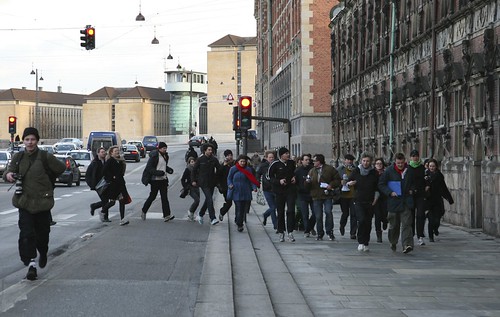
The Critical Run initiative, by Thierry Geoffroy, at first glance, appears exciting. Lighthearted and simple, yet livening. Take a group of people and make them discuss serious issues - while jogging.
Let's run and talk. Let's have fun and share. Let's move. See what happens - to us, to the surroundings, to the topic.
It reminds me of some of the Lone Twin works, and of other, more discursive, initatives.
But then you see the videos.
- and you realize why this is a copyrighted format. Actually, it's not about the conversation at all. It's about the hilarious situation of displacing discourse into a territory that is not its own. It's about creating a mess with a mass. And hoping (?) for a miracle of super-discourse through a discourse-smashing environment. As we all know from films, the most profound ideas arise on boxing rings.
But wait! It gets better!
Oh, Canada!
Think! Exchange! Travel far! As long as you can fit it on a headband...
But let's be honest. Discourse is a problem for the work of art, if it stays within the aesthetic experience. It either gets chewn up by the experience or we move out (last movement?) of the aesthetic experience and into the realm of plays-on-ideas. Which is also a tough blow.
Then we have to face the perspective of functioning as anyone else who thinks. And running with them. And quite possibly getting completely lost, syncopated, out-of-breathed, shafted, as my teenage years would put it (notice the momentum of the word). No wonder one can feel the need to go back and, well, try to, well, do, well, something about the loss. Someone like John Baldessari*, witty enough to both play the artsy world and keep his eyes on the ball:
And, to get a fuller picture, how else, a remix of the remix:
Is the relief you feel when being able to read accompanied by a feeling of the loss of Baldessari's purity? Could it be there is not enough movement? But then again, isn't it nice to feel that a words translates into a thought?
One of the videos of the Critical Runs is entitled "Does the artist has any impact on society?" (sic!)
There is one comment underneath: "Not in bad English you don't. Does anyone have..."
* For a succint intro to John Baldessari, see the stylishly designed FLYP magazine.
Sensing discourse
"- What is the role of the artist?
- To not get tired of running all his life."
The Critical Run initiative, by Thierry Geoffroy, at first glance, appears exciting. Lighthearted and simple, yet livening. Take a group of people and make them discuss serious issues - while jogging.
Let's run and talk. Let's have fun and share. Let's move. See what happens - to us, to the surroundings, to the topic.
It reminds me of some of the Lone Twin works, and of other, more discursive, initatives.
But then you see the videos.
- and you realize why this is a copyrighted format. Actually, it's not about the conversation at all. It's about the hilarious situation of displacing discourse into a territory that is not its own. It's about creating a mess with a mass. And hoping (?) for a miracle of super-discourse through a discourse-smashing environment. As we all know from films, the most profound ideas arise on boxing rings.
But wait! It gets better!
Oh, Canada!
Think! Exchange! Travel far! As long as you can fit it on a headband...
But let's be honest. Discourse is a problem for the work of art, if it stays within the aesthetic experience. It either gets chewn up by the experience or we move out (last movement?) of the aesthetic experience and into the realm of plays-on-ideas. Which is also a tough blow.
Then we have to face the perspective of functioning as anyone else who thinks. And running with them. And quite possibly getting completely lost, syncopated, out-of-breathed, shafted, as my teenage years would put it (notice the momentum of the word). No wonder one can feel the need to go back and, well, try to, well, do, well, something about the loss. Someone like John Baldessari*, witty enough to both play the artsy world and keep his eyes on the ball:
And, to get a fuller picture, how else, a remix of the remix:
Is the relief you feel when being able to read accompanied by a feeling of the loss of Baldessari's purity? Could it be there is not enough movement? But then again, isn't it nice to feel that a words translates into a thought?
One of the videos of the Critical Runs is entitled "Does the artist has any impact on society?" (sic!)
There is one comment underneath: "Not in bad English you don't. Does anyone have..."
* For a succint intro to John Baldessari, see the stylishly designed FLYP magazine.
Thursday, August 6, 2009
Wooster Group's Hamlet (aftermath)

This is not a review. And it will probably remain incomprehensible if you don't at least read what the Wooster Group show is about. So you might want to start off with a positive review and/or a negative one.
(And, possibly, move to an insight into how they prepared it. And an insightful interview about the group. And an interview with Kate Valk.)
I had been waiting to see this for a long time. This is the group I always talk about during workshops and I have never seen act live. This particular show, well, could be an experimentum crucis of my (wavering) faith in theater as a live form of live art. I leave you with my transcribed raw notes from the show, and below, a couple of ideas.

Theater as reproduction
- of what?
of our reality
=> cinema (is our reality)
other way: reality reproduces art
body is our basic reality
body as choreography
BUT it's first and foremost a SHOW
spaces of absence
The dance of the impotent body
to perform = to enact
puppets
retro
conventionality of movement
performance as video art or rather as
echo of image
=> afterimage
--
The action lies between the acts
--
Playing on the players like on instruments
The players accompany a great
video
Is that bad?
"They killed theater" (audience member, calmly)
(So many deaths of theater before)
Good Heavens,
if that be so,
if this is the thing,
I humbly thank you.
Musical work - when works.
Women (Cate Valk, really) have more problems with show formula- because of
more emotional roles?
2nd part much better - uses the new convention.
(but also ends up more conventional)
Hamlet - actor - manipulates the actors - logical gesture.
Strong
--
search for an
aesthetic experience
(e.g. songs)
showSHOWshowSPECTACLE
---
Warping time/space
But then it becomes simply multimedia entertainment.
+ + +
A man crosses the stage, says Peter Brook, and you have theater.
Pathos. That's what you get when a man crosses the stage. Anthropocentrism. The idea that it's all about us, really. The sin of vanity in all its splendor.
Who are we, really (on stage)?
How do we conduct our paths (on stage)?
What can we see if we introduce breaks into the surface of our behavior (on stage)?
The body becomes heavy.
It becomes an accessory. An object more than a tool. An instrument that cannot be played in a clean way is more of itself. It is less melody, and more instrument.
This body that struggles to fit into the image that will always outsmart it.
Their "on/off" stage presence (in the middle of a scene: "Let's skip this dialogue") is not shocking, it is part of the language of contemporary performance. It is part of our thinking, feeling of the frame/work of art as ambiguously present, intermittently present. Nice: it's when it turns us on, not the other way around. Hence the decadent flirt, hence the false opening, hence the play outside of a play outside of a play.
______________________________

What do you want out of this? Out of this experience? What do you want out of a play?
Try this: Say: This is silly. Say: Theater is the essence of the misconception that it is all about the human. It is the place of the old-fashioned, stubborn faith in 1) the communion of the believers, and 2) the hierarchy of presentation. It is a stage which seems so enchanted with the universal human condition, it forgets the subtle yet profound changes of the aesthetic, the sensible, the eye of the beholder. It is a place whose very existence in these times is so out of joint, it is funny.
But what if we accepted this as part of the game? What if we played this game, using this as a platform to inquire into what conditions we are in, as the humans that have no choice but to, at one point or another, remain anthropocentric? What if we surrendered to the collision of times, this our present time of, say, having to read this text one line at a time, and the time of too many lines behind, and the time of too many lines besides, after, above? What sort of figures are we once we let go of our need for the unique now? Entirely?
Sensation> This our too too solid flesh is extremely flexible. And it goes along with the lines of tension, it follows the cracks and bounces off whatever is left as the aftermath.
Abstract? No, this is not abstract. It means: somehow, miraculously, we deal with change, since we live through it. And yet, we do not melt, we do not resolve ourselves into a dew. If we manage to tune in - we dance. Every step, stumble, vibration becomes a choreography of ourselves.
Sensation> We are not enough. The body fights to correspond to the twitches of the images, yet it lags behind. The eyes go back to the screen. We have no way of knowing how correct we are, yet the need of knowledge unveils our total, complete inadequacy. We are but thinking puppets, we are but repeating Plato, we are but warming up the stage for the image that comes behind. Whatever surrounds us is more powerful, and yet -
Sensation> The eye of the beholder might make a difference. The beholder as object, the beholder as a weaker alter ego. The beholder as the one who submits to the role of a prop, and whose tragedy, a subject realizing he is an object, becomes the juiciest work, the perfect crack in the façade of the perfect spectacle.
Oh, and don't pay attention to the ending. Don't pay attention to the illusion that the slave has become the master, that the technology is, after all, a tool, that we can use the past, control the present, cope with the future, that things are what we want them to be. Don't fall in the trap of theater, which numbs us into believing it's okay, images end, we are here, devising our entries and winning our exits.
There is a stage behind that one. But on it - well, take a peak.
Wooster Group's Hamlet (aftermath)
This is not a review. And it will probably remain incomprehensible if you don't at least read what the Wooster Group show is about. So you might want to start off with a positive review and/or a negative one.
(And, possibly, move to an insight into how they prepared it. And an insightful interview about the group. And an interview with Kate Valk.)
I had been waiting to see this for a long time. This is the group I always talk about during workshops and I have never seen act live. This particular show, well, could be an experimentum crucis of my (wavering) faith in theater as a live form of live art. I leave you with my transcribed raw notes from the show, and below, a couple of ideas.
Theater as reproduction
- of what?
of our reality
=> cinema (is our reality)
other way: reality reproduces art
body is our basic reality
body as choreography
BUT it's first and foremost a SHOW
spaces of absence
The dance of the impotent body
to perform = to enact
puppets
retro
conventionality of movement
performance as video art or rather as
echo of image
=> afterimage
--
The action lies between the acts
--
Playing on the players like on instruments
The players accompany a great
video
Is that bad?
"They killed theater" (audience member, calmly)
(So many deaths of theater before)
Good Heavens,
if that be so,
if this is the thing,
I humbly thank you.
Musical work - when works.
Women (Cate Valk, really) have more problems with show formula- because of
more emotional roles?
2nd part much better - uses the new convention.
(but also ends up more conventional)
Hamlet - actor - manipulates the actors - logical gesture.
Strong
--
search for an
aesthetic experience
(e.g. songs)
showSHOWshowSPECTACLE
---
Warping time/space
But then it becomes simply multimedia entertainment.
+ + +
A man crosses the stage, says Peter Brook, and you have theater.
Pathos. That's what you get when a man crosses the stage. Anthropocentrism. The idea that it's all about us, really. The sin of vanity in all its splendor.
Who are we, really (on stage)?
How do we conduct our paths (on stage)?
What can we see if we introduce breaks into the surface of our behavior (on stage)?
The body becomes heavy.
It becomes an accessory. An object more than a tool. An instrument that cannot be played in a clean way is more of itself. It is less melody, and more instrument.
This body that struggles to fit into the image that will always outsmart it.
Their "on/off" stage presence (in the middle of a scene: "Let's skip this dialogue") is not shocking, it is part of the language of contemporary performance. It is part of our thinking, feeling of the frame/work of art as ambiguously present, intermittently present. Nice: it's when it turns us on, not the other way around. Hence the decadent flirt, hence the false opening, hence the play outside of a play outside of a play.
______________________________
What do you want out of this? Out of this experience? What do you want out of a play?
Try this: Say: This is silly. Say: Theater is the essence of the misconception that it is all about the human. It is the place of the old-fashioned, stubborn faith in 1) the communion of the believers, and 2) the hierarchy of presentation. It is a stage which seems so enchanted with the universal human condition, it forgets the subtle yet profound changes of the aesthetic, the sensible, the eye of the beholder. It is a place whose very existence in these times is so out of joint, it is funny.
But what if we accepted this as part of the game? What if we played this game, using this as a platform to inquire into what conditions we are in, as the humans that have no choice but to, at one point or another, remain anthropocentric? What if we surrendered to the collision of times, this our present time of, say, having to read this text one line at a time, and the time of too many lines behind, and the time of too many lines besides, after, above? What sort of figures are we once we let go of our need for the unique now? Entirely?
Sensation> This our too too solid flesh is extremely flexible. And it goes along with the lines of tension, it follows the cracks and bounces off whatever is left as the aftermath.
Abstract? No, this is not abstract. It means: somehow, miraculously, we deal with change, since we live through it. And yet, we do not melt, we do not resolve ourselves into a dew. If we manage to tune in - we dance. Every step, stumble, vibration becomes a choreography of ourselves.
Sensation> We are not enough. The body fights to correspond to the twitches of the images, yet it lags behind. The eyes go back to the screen. We have no way of knowing how correct we are, yet the need of knowledge unveils our total, complete inadequacy. We are but thinking puppets, we are but repeating Plato, we are but warming up the stage for the image that comes behind. Whatever surrounds us is more powerful, and yet -
Sensation> The eye of the beholder might make a difference. The beholder as object, the beholder as a weaker alter ego. The beholder as the one who submits to the role of a prop, and whose tragedy, a subject realizing he is an object, becomes the juiciest work, the perfect crack in the façade of the perfect spectacle.
Oh, and don't pay attention to the ending. Don't pay attention to the illusion that the slave has become the master, that the technology is, after all, a tool, that we can use the past, control the present, cope with the future, that things are what we want them to be. Don't fall in the trap of theater, which numbs us into believing it's okay, images end, we are here, devising our entries and winning our exits.
There is a stage behind that one. But on it - well, take a peak.
Thursday, July 23, 2009
Lapidating Modern Art


A few days ago I witnessed an excessively sad event. A huge group of merchants was thrown out (by the police) of a hall in the center of Warsaw (which they had been renting for several years), and the events turned violent and nasty, with throwing of stones and fights and tear gas and general havoc.
Although it did look like some sort of incomprehensible flash mob or other performative party, one could hardly squeeze it into the “new art” category, were it not for one significant detail: the commercial hall is to be substituted by the Museum of Modern Art. Of course, the city authorities claim the undoing of this most hideous hall is necessary for the construction of a second line of the metro, but the fact is: the temple of 90’s-style small, bad quality commerce will be replaced by the temple of contemporary art.
The obvious implication of this week’s events is: the Museum of Modern Art will arguably be the most despised building in Poland. So far, the only (extremely heated) debates about its character, name (Contemporary or Modern?), and, of course, its shape, interested only fairly elite circles. The building itself raised most controversy, with its austere, “modernist”, or, as some put it, uninspired look. But all this was nothing compared to what happened last Tuesday: the masses moved. There was naturally no talk of the museum. Yet sooner or later, the topic will appear. The Museum will be built, and the tens of thousands of people around the country who considered what happened an act of injustice will have a surprizingly clear symbolic enemy: Modern Art.
But the hundreds of people gathered at the hall entrance would not be customers anyway. Meaning, they don’t fit the profile. Not the current one, and not any potential profile of someone “we” seem to want to educate into (our) art, into (our) culture. Why? Because the social differences are so big, it is still unimaginable for the common art curator/cultural agent to think of these people as spectators, art amateurs, partners. Just as they were hardly a partner for negotiating a new commercial deal (they rejected several offers and refused to participate in further negotiations). We will hear: They are outside of the reach of... of us, the cultural people, the elites, the-educated-ones. They are a lost case.
This is obviously the moment when the conflict becomes helpless. Each party is convinced that the others are barbarians, their entire world is wrong, corrupt, and unworthy of any contact.
Do these people need us to defend them? I believe this is not a question of need. It is a question of true access to culture. Of initiatives, or rather, structures, which would allow for a potential integration of all citizens.
The Museum of Modern Art has already had many great exhibitions. But these initiatives are clearly focused on a prestigious audience, they are intellectually sophisticated, but beyond that, they don’t seem to reach out to a “larger” audience. This reaching out has been happening in many museums around the world (take the Brooklyn Museum, with their great program of interactive activities where once a month visitors can have a totally different experience of art, which includes, for instance, making their own art prints and parties with known DJs).
In Warsaw, we have a truly outstanding exhibition relating to the great Alina Szapocznikow, an artist whose work is largely unknown outside of Poland, yet here is already considered as a crucial reference for anyone interested in modern art (the exhibition ends Sunday). Her works combine eroticism with power, femininity with a great understanding of structure and drama. Possibly the most impressive among the works presented at the show is the huge female belly sculpted in marble (actually it's a double-belly), which impresses, attracts, scares, and ultimately leaves us at a (as always unbearable) distance. What is made to counteract this distance in terms of programming? Some lectures, discussions, guided tours, and a new documentary film. All this is great for me or you. Interesting indeed.
But what about the reaching out? The search for new, active audiences?
Well, many of the women present during the events at the commercial hall were convinced to join in the creative thinking about stone – they reached out, grabbed the pavement stones, and threw them at the police. I claim they did it not only because they were “part of the mob”, but also, because they were hardly ever offered any serious alternatives.
Isn’t it time we thought about those others as true potential consumers of culture, who can be sought just as we seek the already accustomed artsy amateurs?

A friend of mine suggested that the 2000 salesmen thrown out on Tuesday be hired at the Museum Store.
Beyond this ironic (and hilarious) take lies the feeling that something is going terribly wrong in the way we are approaching the idea of social change.
I have been often showcasing projects with social agendas. They were more out-going, accessible, they were social sculptures or other initiatives which claimed a different approach to the audience-connection.
But at such instances, I wonder: can't social sculpture strive for effectiveness? Isn't it terribly passé to hide behind our we-are-only-poor-artists shields?
PS. The Museum of Modern Art does attempt to create a social space of dialogue, as in the initiative of a Park of Sculpture in a poor part of Warsaw. One can see the idea. Yet paradoxically even an artist like Rirkrit Tiravanija seems to have transformed of his relational aesthetics here into a... well... esoteric sculpture.
 Hopefuly, this cube, and tens of other artcubes, can make a difference. Yet for the moment its futuristic, mirror-like shape seems all but ironic.
Lapidating Modern Art
A few days ago I witnessed an excessively sad event. A huge group of merchants was thrown out (by the police) of a hall in the center of Warsaw (which they had been renting for several years), and the events turned violent and nasty, with throwing of stones and fights and tear gas and general havoc.
Although it did look like some sort of incomprehensible flash mob or other performative party, one could hardly squeeze it into the “new art” category, were it not for one significant detail: the commercial hall is to be substituted by the Museum of Modern Art. Of course, the city authorities claim the undoing of this most hideous hall is necessary for the construction of a second line of the metro, but the fact is: the temple of 90’s-style small, bad quality commerce will be replaced by the temple of contemporary art.
The obvious implication of this week’s events is: the Museum of Modern Art will arguably be the most despised building in Poland. So far, the only (extremely heated) debates about its character, name (Contemporary or Modern?), and, of course, its shape, interested only fairly elite circles. The building itself raised most controversy, with its austere, “modernist”, or, as some put it, uninspired look. But all this was nothing compared to what happened last Tuesday: the masses moved. There was naturally no talk of the museum. Yet sooner or later, the topic will appear. The Museum will be built, and the tens of thousands of people around the country who considered what happened an act of injustice will have a surprizingly clear symbolic enemy: Modern Art.
But the hundreds of people gathered at the hall entrance would not be customers anyway. Meaning, they don’t fit the profile. Not the current one, and not any potential profile of someone “we” seem to want to educate into (our) art, into (our) culture. Why? Because the social differences are so big, it is still unimaginable for the common art curator/cultural agent to think of these people as spectators, art amateurs, partners. Just as they were hardly a partner for negotiating a new commercial deal (they rejected several offers and refused to participate in further negotiations). We will hear: They are outside of the reach of... of us, the cultural people, the elites, the-educated-ones. They are a lost case.
This is obviously the moment when the conflict becomes helpless. Each party is convinced that the others are barbarians, their entire world is wrong, corrupt, and unworthy of any contact.
Do these people need us to defend them? I believe this is not a question of need. It is a question of true access to culture. Of initiatives, or rather, structures, which would allow for a potential integration of all citizens.
The Museum of Modern Art has already had many great exhibitions. But these initiatives are clearly focused on a prestigious audience, they are intellectually sophisticated, but beyond that, they don’t seem to reach out to a “larger” audience. This reaching out has been happening in many museums around the world (take the Brooklyn Museum, with their great program of interactive activities where once a month visitors can have a totally different experience of art, which includes, for instance, making their own art prints and parties with known DJs).
In Warsaw, we have a truly outstanding exhibition relating to the great Alina Szapocznikow, an artist whose work is largely unknown outside of Poland, yet here is already considered as a crucial reference for anyone interested in modern art (the exhibition ends Sunday). Her works combine eroticism with power, femininity with a great understanding of structure and drama. Possibly the most impressive among the works presented at the show is the huge female belly sculpted in marble (actually it's a double-belly), which impresses, attracts, scares, and ultimately leaves us at a (as always unbearable) distance. What is made to counteract this distance in terms of programming? Some lectures, discussions, guided tours, and a new documentary film. All this is great for me or you. Interesting indeed.
But what about the reaching out? The search for new, active audiences?
Well, many of the women present during the events at the commercial hall were convinced to join in the creative thinking about stone – they reached out, grabbed the pavement stones, and threw them at the police. I claim they did it not only because they were “part of the mob”, but also, because they were hardly ever offered any serious alternatives.
Isn’t it time we thought about those others as true potential consumers of culture, who can be sought just as we seek the already accustomed artsy amateurs?
A friend of mine suggested that the 2000 salesmen thrown out on Tuesday be hired at the Museum Store.
Beyond this ironic (and hilarious) take lies the feeling that something is going terribly wrong in the way we are approaching the idea of social change.
I have been often showcasing projects with social agendas. They were more out-going, accessible, they were social sculptures or other initiatives which claimed a different approach to the audience-connection.
But at such instances, I wonder: can't social sculpture strive for effectiveness? Isn't it terribly passé to hide behind our we-are-only-poor-artists shields?
PS. The Museum of Modern Art does attempt to create a social space of dialogue, as in the initiative of a Park of Sculpture in a poor part of Warsaw. One can see the idea. Yet paradoxically even an artist like Rirkrit Tiravanija seems to have transformed of his relational aesthetics here into a... well... esoteric sculpture.
Hopefuly, this cube, and tens of other artcubes, can make a difference. Yet for the moment its futuristic, mirror-like shape seems all but ironic.
Wednesday, June 3, 2009
Aliens in Brussels - Althamer's "Common Task"

On June 4, 1989, Poland held the first (partly) free elections of the so-called Eastern Block.
It was the first time since WW2 that opposition parties could legally participate in the political process, and the result - a smashing success of the opposition - was the end of communism and the beginning of a new, free Poland. These elections are generally considered the single event that began the overcoming of the totalitarian regimes in this entire region of the world.
And among the ways in which Poland will be celebrating the 20th anniversary of these events, one is particularly interesting.
Tomorrow, the excellent Polish artist Paweł Althamer (I've written a short note about him before), will land with 160 other passengers of a Boeing 737 in Brussels. They will all be wearing golden suits that look like a combination of space suits and fairy-tale costumes. Even the plane will be specially designed and painted gold - all as part of Althamer's work Common Task (the Polish expression "Wspólna sprawa" could also mean "common issue" or "common quest"). Their first stop in the city will be the Expo 58, a modernist dream-town. A model of an atom will be a starting point of the visit to the European Parliament and "meetings with the residents of the city" (How does that work?). They will be making a tour of the city as strange, alien visitors. 160 gold-dressed aliens.
 Who are they? Mainly Althamer's neighbors, family and friends, who have been joining him for other performances he organized.
Who are they? Poles. Strangers. People from outer space.
They are the winners. The visiting winners. The happy neighbors. The curious onlookers, the modernist dreamers, the naive children of freedom, the believers. They are the pure creators, the dreamed Europeans, the perfect people, they are the unexpected turn of events, where everything turns gold.
The words on the page of the entire commemoration state:
The motto of the commemoration, It all began in Poland, is a bold reference to the fact that Poland was the first European nation to oppose, in 1939, the spread of Nazism and communism, and was the first to remove their communist government from power in 1989.The gold suits seem to fit. And yet, what I like about this social sculpture (as Althamer sometimes calls his works) is something quite opposite to that spirit of heroism and pride we so desperately claim. It's... you guessed it - the lack of pathos.
Or rather - the way pathos is masked by the gold suit.
(In the video, art critic and curator Anda Rottenberg talks about Althamer's social sculptures: "It is about involving everyone in the area of the work of art as an activity where a new reality is created together and the chain of events is directed together".)
UPDATE 05.06.09:
Althamer told the media:
There are no VIPs here. This is a grass-roots project, in which ordinary people participate. It reminds that ordinary people are the ones who can change reality. 20 years ago no one expected that Poland would be free. We thought it was impossible. Our astronauts also never expected to fly to Brussels in a golden airplane. We set to have fun and enjoy freedom.
and the project's curatorial decription tells the story in a broader context:
The participants, i.e. the residents of the Bródno district in Warsaw appear in various places in extraordinary golden spacesuits. The joint activities are aimed to cross not only the mental but also the physical barriers; in addition to the meetings which are set in everyday reality, the participants also set out on peculiar journeys offering them new possibilities and unusual experiences. Clad in extraordinary spacesuits they balance on the border of two worlds; the one that they know and the new one which is very often a projection of their imagination. The world that they know quite frequently means the unattractive space of the grey and gloomy blocks of flats. The participants are “ordinary” people who have “ordinary” jobs and who are just “people from across the street”. “Common Task” allows them to leave the twilight zone and to appear in a public space which is completely new to them. For them, it is a different world full of people communicating in a foreign language. But it is also the world in which they become visible. What is more, they become the focal point and draw attention of the other people.In this context the Project of Paweł Althamer can be viewed as a social sculpture. The sculpture which is a material object, is transformed into a common experience, a process aimed to introduce a deep going change in the registers of everyday habits. Subject to this artistic transformation is not only a physical object but also the person, consciousness and mental habits. At the same time, Common Task is a meeting and integration place of various social groups and people whose everyday realities do not merge in any way and who are often excluded from the social and cultural rites. The symbolic crossing of the borders thus occurs at many levels.


It's curious how the vectors of meaning change. The beginning of the project seems to have been indeed a venture into the unknown, a play with the modernist ideas and ideals of unity, purity, but also of exceptionality of the individual. The trip to the city of Brasilia which they undertook underlines it quite clearly. However, by now the project is huge, the date is a specific date, not a coincidence, and these "neutral" people are not neutral any more - they are the golden ambassadors of the Polish cause. They are, whether the artist wants it or not, the symbol of the Polish events in 1989. And to some extent it becomes irrelevant what their reasons for going were, as the impact of their presence puts them in a very specific role, molds them into a social sculpture quite different from the one described in such a neutral way by the artist. There is a tension between the way the work "should" be seen, and how it appears. Curiously, the media's coverage shows the ambiguity: the journalists would like to show the richness of stories and levels of the work they are participating in (they, too, have to wear the golden suits), yet the bottom line keeps bringing them back to this "gold-medal" aproach, where the Poles are the clear winners of some strange competition.
This development of the "Common Task" is a great example of how the historic identity challenges, distorts, and often overwhelms the personal-narrative-identity.
(with a little help from Polandian)
Subscribe to:
Posts (Atom)


